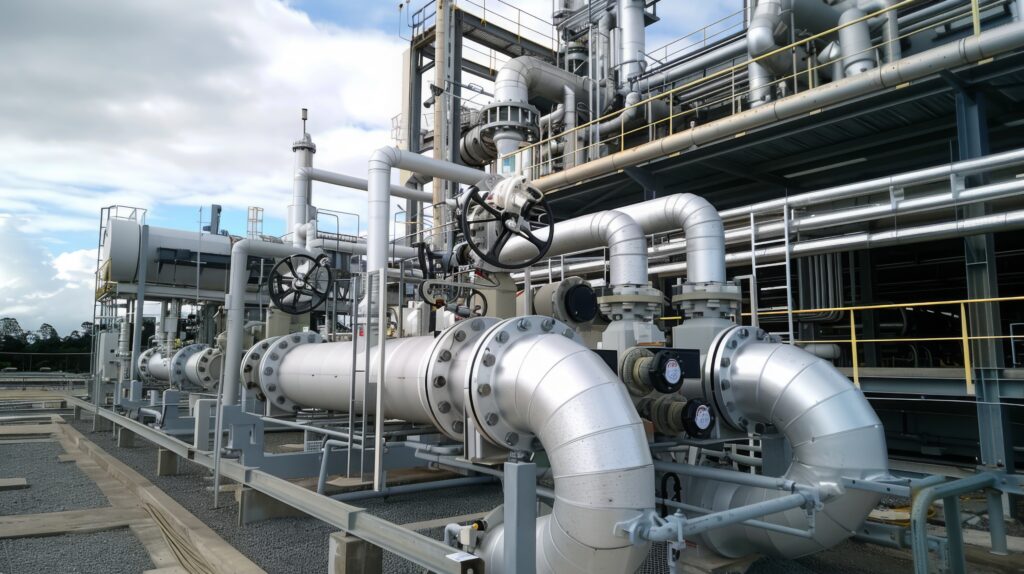
Raw wellhead gas rarely looks anything like the fuel that eventually reaches a burner tip or a compressor station downstream. Gas processing is the set of engineering steps that closes that gap turning a mixture loaded with water vapor, heavy hydrocarbons, and acid gases into a clean, pipeline-spec product. For operators in India, where domestic gas is being pushed harder than ever to meet City Gas Distribution (CGD) and industrial demand, getting this step right determines whether a field’s gas is even sellable.
What Is Gas Processing?
Gas processing is the sequence of physical and chemical treatment steps applied to produced natural gas before it can enter a transmission pipeline or be used as feedstock. Gas straight from the wellhead typically carries water vapor, hydrogen sulfide (H₂S), carbon dioxide (CO₂), and heavier hydrocarbon fractions (NGLs) along with the methane.
Left untreated, that mixture causes real problems. Water vapor combines with light hydrocarbons under pressure to form hydrates ice-like solids that block pipelines and instrumentation. Acid gases like CO₂ and H₂S corrode carbon steel piping and vessels, and H₂S is toxic even at low concentrations. Heavier hydrocarbons condense out unpredictably, distorting the gas’s heating value and violating pipeline sales specifications. Processing exists to remove all of this before the gas leaves the facility.
Core Systems in a Gas Processing Train
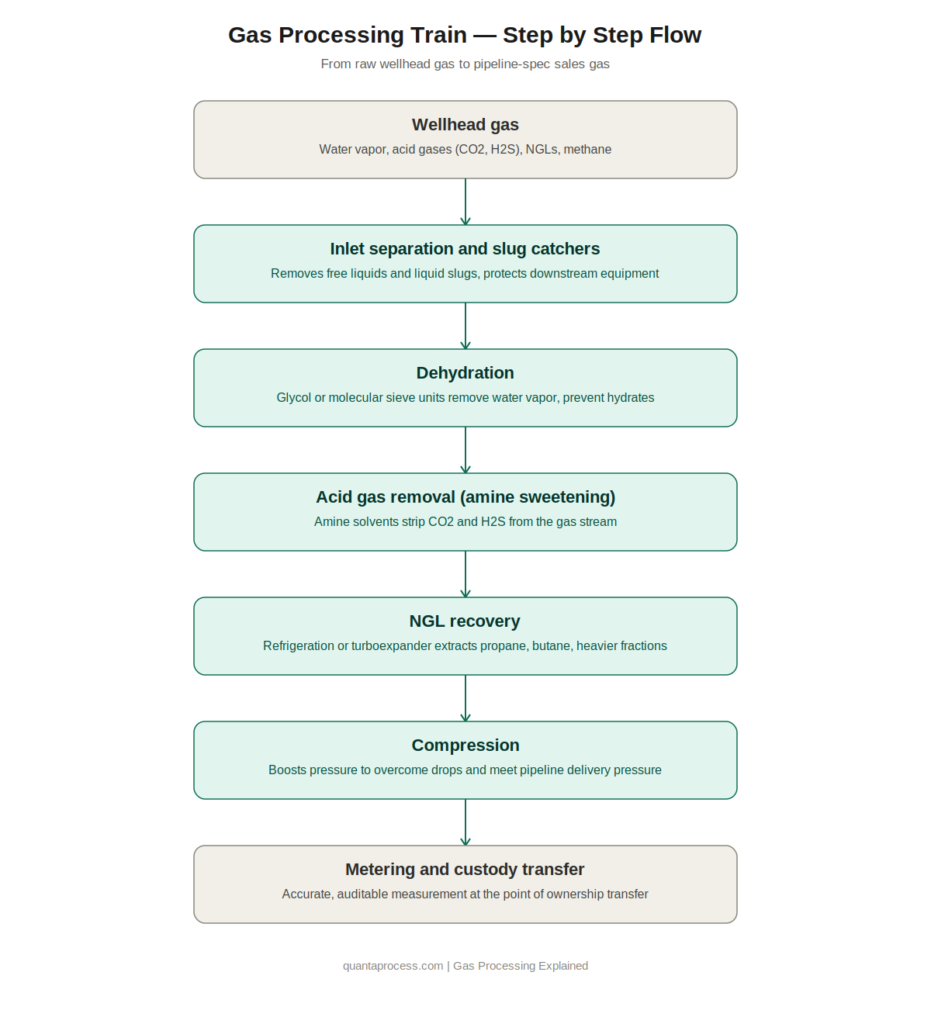
A typical processing train strings together several unit operations, each targeting a specific contaminant or product stream.
Inlet separation and slug catchers — The first stage knocks out free liquids and handles slugs of liquid that arrive with the gas stream, protecting downstream equipment from surges.
Dehydration (glycol or molecular sieve) — Removes water vapor to prevent hydrate formation and corrosion. Glycol (TEG) units are common for moderate dew-point requirements; molecular sieves are used where very low water content is needed, such as ahead of cryogenic NGL recovery.
Acid gas removal / sweetening (amine treating) — Amine solvents strip out CO₂ and H₂S, protecting metallurgy downstream and meeting pipeline sulfur specs.
NGL recovery (refrigeration or turboexpander) — Extracts propane, butane, and heavier fractions as liquid products, both to meet the sales gas heating value spec and to capture additional revenue streams.
Compression — Boosts pressure at multiple points in the train to overcome pressure drops and to meet pipeline delivery pressure.
Metering and custody transfer — Ensures accurate, auditable measurement of gas volume and quality at the point where ownership transfers to the pipeline operator or buyer.
Why Gas Processing Matters for Indian Oil & Gas Projects
India’s domestic gas story is increasingly about smaller and marginal fields, associated gas that used to be flared, and a CGD network expanding into tier-2 and tier-3 cities. Monetizing associated gas from oil fields depends entirely on having processing capacity available close to the wellhead; otherwise, it gets flared as a stranded byproduct. Meanwhile, every molecule entering the pipeline grid has to meet strict quality specifications, so processing isn’t optional; it’s the difference between a saleable asset and a flare stack.
Modular Gas Processing: When It Makes Sense
Marginal and remote fields often can’t justify a full stick-built processing plant. Modular, skid-mounted gas processing units are designed, fabricated, and tested off-site, then shipped and tied into the field with minimal on-site construction. This shortens deployment timelines significantly, reduces the site construction risk that comes with congested or remote locations, and makes brownfield tie-ins into existing gathering systems far more manageable. For operators weighing capex against field life, modular systems are frequently the more practical route. Our team covers this approach in more depth in our skid-mounted systems post.
Engineering Challenges to Plan For
Gas processing design carries real technical risk if these issues aren’t addressed early:
- Corrosion under insulation (CUI) on chilled or intermittently wet lines, which can hide serious wall loss behind intact-looking insulation.
- Hydrate formation at points where pressure drops and temperature falls, particularly around choke valves and control valves.
- Sour service metallurgy H₂S-bearing streams require materials selection compliant with NACE MR0175/ISO 15156 to avoid sulfide stress cracking.
- HAZOP reviews a structured hazard and operability study is essential before finalizing the process design, catching failure modes that a single-discipline review would miss.
How Quanta Supports Gas Processing Projects
Quanta Process & Project Services works across the full gas processing lifecycle conceptual design, FEED, detailed engineering, and commissioning support for both stick-built and modular deliveries. Our Oil & Gas Processing supply line is built specifically around delivering engineered modular solutions for upstream and midstream operators, drawing on nearly 25 years of process engineering experience across sour and sweet gas services.
If you’re evaluating a gas processing scope. whether it’s a new field development or a retrofit to meet tighter pipeline specs. our team can walk through the feasibility with you. Get in touch to start a gas processing feasibility review.
FAQ